
When people search online for “fly agaric for sale,” “buy fly agaric,” or “dried fly agaric,” they usually see only the final product: dried caps, carefully packed pieces, product photos, and short descriptions.
But the real quality of Amanita Muscaria begins much earlier.
It begins in the forest, long before the mushroom is dried, sorted, packed, or offered online. It begins with the season, the weather, the condition of the forest floor, the maturity of the caps, and the experience of the people selecting them.
Amanita Muscaria is not a standardized factory-made product. It is a natural mushroom with visible seasonal differences. Some years bring firm, clean, beautifully shaped caps. Other years are more difficult, with too much moisture, softer mushrooms, or smaller harvests.
That is why careful harvesting matters so much.
Why Amanita Muscaria Harvesting Requires Experience
At first glance, Amanita Muscaria can look easy to recognize. Its red cap, white spots, and distinctive appearance make it one of the most recognizable mushrooms in the world.
However, recognizing the mushroom is only one part of the process.
Harvesting high-quality Amanita Muscaria requires attention to details such as:
- cap maturity,
- moisture level,
- visible damage,
- texture,
- firmness,
- color stability,
- and overall condition.
Not every mushroom that looks good in the forest is suitable for drying. Some caps may appear bright and attractive from above, but feel too soft underneath. Others may have absorbed too much moisture after heavy rain.
This is why experienced selection is important. The goal is not simply to collect as many mushrooms as possible. The goal is to choose mushrooms that can become a stable, clean, and well-preserved dried product.
The Forest Conditions That Influence Quality
The quality of Amanita Muscaria is strongly influenced by the environment in which it grows.
Forest type, humidity, temperature, rainfall, and soil conditions can all affect the appearance and structure of the mushrooms. Cooler regions often produce firm and visually striking caps, but wet autumn weather can make the harvesting process much more challenging.
A dry, cool period may result in cleaner and more stable mushrooms. A very rainy period, on the other hand, can create softer caps, excess moisture, and a higher risk of damage during handling.
This is why two harvests from different seasons may look noticeably different, even when they come from similar natural environments.
Small differences are normal. Amanita Muscaria is a natural product, and natural variation should be expected. The important question is whether the mushrooms are selected, sorted, and handled with enough care.
Why Not Every Beautiful Mushroom Is Selected
One of the most common misconceptions is that appearance alone determines quality.
A bright red cap can look impressive, but color is only one part of the picture. During harvesting, other factors matter just as much.
A mushroom may be rejected if it is:
- too wet,
- too soft,
- damaged by insects,
- heavily broken,
- covered with dirt that cannot be cleaned properly,
- too old,
- or already beginning to lose structure.
This careful rejection process is important. It may reduce the quantity of the final batch, but it helps protect the overall quality.
When someone searches for “buy Amanita Muscaria” or “order fly agaric,” they rarely see this part of the process. Yet this is one of the most important stages behind the final product.
Good quality is not only about what is collected. It is also about what is left behind.
The Role of Timing During the Harvest Season
Timing can make a significant difference.
Amanita Muscaria should not be harvested too early, when the caps are not fully developed, but waiting too long can also reduce quality. Older mushrooms may become softer, darker, more fragile, or more difficult to dry evenly.
The best harvesting window is often short. Weather conditions can change quickly, especially during autumn. A few days of rain can significantly affect the moisture content and structure of the mushrooms.
This is why harvesting is not simply a one-time activity. It often requires checking conditions, observing the forest, comparing different areas, and making careful decisions based on the actual season.
This kind of experience is difficult to replace with automated processes or generic sourcing.
What Happens After Harvesting
The first steps after harvesting are just as important as the selection in the forest.
Fresh Amanita Muscaria must be handled carefully to avoid unnecessary damage. The caps are naturally delicate, especially when moisture levels are high. Rough handling can break the structure and reduce the quality of the final dried product.
After harvesting, the mushrooms are usually reviewed again. This second inspection helps separate pieces that may not have been clearly questionable in the forest but become easier to evaluate during sorting.
At this stage, attention is given to:
- remaining moisture,
- visible damage,
- cap structure,
- cleanliness,
- size,
- and drying suitability.
This step is important because dried fly agaric quality depends heavily on what happens before the drying process even begins.
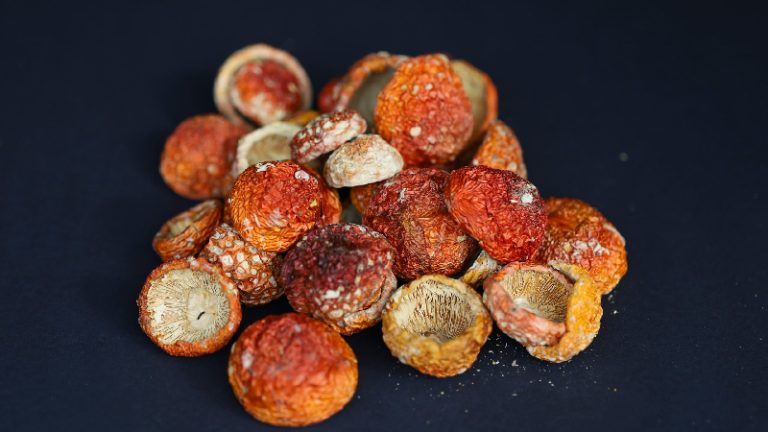

Why Harvesting and Drying Are Connected
Many people think of harvesting and drying as two separate steps. In reality, they are closely connected.
A mushroom that is too wet, too old, or too soft will be more difficult to dry properly. Even the best drying method cannot fully correct poor selection.
This is why careful harvesting supports better drying results. Firm, well-selected caps are more likely to dry evenly, keep a cleaner structure, and remain more stable during storage.
When people search for “dried fly agaric,” they often compare final products by color or price. But the drying result is strongly influenced by the quality of the fresh mushrooms chosen in the first place.
Good drying begins with good selection.
Why Transparency Matters in Amanita Muscaria Sourcing
Amanita Muscaria is a sensitive niche, and buyers are becoming more careful. Many people no longer want vague product descriptions or unrealistic claims. They want to understand where the product comes from, how it is selected, and what quality actually means.
A transparent supplier should be willing to explain:
- how mushrooms are selected,
- why some caps are rejected,
- how seasonal differences affect appearance,
- why batches may vary,
- and how the product is prepared before drying.
This type of information builds trust because it shows that the supplier understands Amanita Muscaria as a real natural product, not just as a trend.
It also helps buyers make more informed decisions when they compare different products or search for fly agaric online.
The Difference Between Mass Collection and Careful Selection
There is a major difference between simply collecting mushrooms and carefully selecting them.
Mass collection focuses mainly on quantity. Careful selection focuses on condition, structure, cleanliness, and suitability for drying.
For Amanita Muscaria, this difference matters a lot.
A large batch is not automatically a good batch. If too many wet, old, or damaged mushrooms are included, the overall quality can suffer. Smaller, carefully selected batches may be more consistent and easier to handle properly.
This is one reason why natural Amanita Muscaria products can vary from season to season. Quality-focused selection often means accepting smaller quantities when the forest conditions are not ideal.
Our Approach at WildAmanita
At WildAmanita, we see Amanita Muscaria as a natural product that deserves patience, care, and respect.
Our approach is based on:
- small-batch selection,
- careful inspection,
- attention to seasonal differences,
- transparent processing,
- and respect for the natural character of Amanita Muscaria.
We do not believe that every mushroom should be collected simply because it is available. Selection is part of quality. Sorting is part of quality. Honest communication is part of quality.
Not every season is the same. Not every batch looks identical. But a careful approach helps ensure that the final dried product is clean, stable, and honestly represented.
Conclusion: Quality Begins Before the Product Page
Amanita Muscaria harvesting is one of the most important stages behind the final product. Before anyone sees dried caps in a package or reads a product description online, many quality decisions have already been made.
The forest, the season, the weather, the timing, the selection, and the first handling steps all influence the result.
Whether someone searches for “buy fly agaric,” “fly agaric for sale,” “order fly agaric,” or “dried fly agaric,” the most important question is not only where to buy it. It is also how the product was selected and prepared before it ever reached the shop.
High-quality Amanita Muscaria begins in the forest — with careful observation, responsible selection, and respect for the natural product.
FAQ
Why does Amanita Muscaria quality vary from season to season?
Amanita Muscaria is a natural product, and its quality depends on weather, moisture, forest conditions, harvest timing, and careful selection.
Is color the most important quality factor?
No. A bright red cap can look attractive, but moisture, texture, smell, structure, and drying suitability are equally important.
Why are some mushrooms rejected during harvesting?
Some mushrooms may be too wet, too soft, damaged, too old, or unsuitable for proper drying. Rejecting them helps protect overall batch quality.
Does harvesting affect dried fly agaric quality?
Yes. The quality of dried fly agaric depends heavily on the condition of the mushrooms before drying. Good drying begins with good selection.
Why is transparency important when buying Amanita Muscaria?
Transparency helps buyers understand origin, selection, drying preparation, and natural batch differences. It also helps avoid unrealistic expectations and low-quality products.