
Amanita mushrooms have fascinated researchers, foragers, and cultural historians for centuries. Among the many species in the Amanita family, Amanita Pantherina (Panther Cap) and Amanita Muscaria (Fly Agaric) stand out as two of the most recognized and frequently compared. Although these mushrooms share visual similarities and belong to the same taxonomic family, they differ significantly in appearance, chemistry, traditional reputation, and risk level.
Therefore, understanding their differences plays a critical role in accurate identification and safe interaction with wild mushrooms.
What Is Amanita Muscaria? Basic Overview
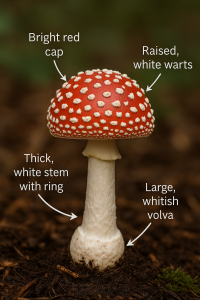
Amanita Muscaria, commonly known as Fly Agaric, is one of the most iconic mushrooms on earth. Traditionally, people recognize it by its bright red cap and distinctive white spots. It grows widely across Europe, North America, Asia, and Northern climates, often forming symbiotic relationships with birch, spruce, and pine trees. Moreover, it usually fruits during late summer and autumn, depending on regional weather patterns.
This species has a long history in folklore, mythology, and indigenous cultural traditions, particularly in Siberia and Northern Europe. Many societies valued it for spiritual and ceremonial purposes, and artists often depicted it in fairy-tale illustrations and literature.
What Is Amanita Pantherina? Basic Overview
Amanita Pantherina, or Panther Cap, appears less frequently in popular culture; however, it remains well-known among mycologists and experienced foragers. It typically features a brown to dark chocolate-colored cap, decorated with white patches. Amanita Pantherina grows across Europe, Asia, North America, and parts of Japan, favoring mixed forests with oak, pine, fir, and cedar.
The fruiting season generally spans summer through late autumn, depending on humidity and temperature conditions. Although visually less dramatic than Amanita Muscaria, Pantherina attracts scientific interest because of its higher concentration of active compounds, which contribute to significantly stronger physiological effects. Therefore, proper identification becomes essential.
Appearance Comparison: Visual Differences
Although these two mushrooms share a similar structure, several key visual details help distinguish them clearly.
Cap Color and Pattern
Amanita Muscaria displays a vivid red or orange-red cap, sprinkled with distinct white wart-like spots.
Amanita Pantherina presents a brown, olive-brown, or dark chocolate cap, with smaller irregular white patches that often appear more flattened.
Consequently, cap color becomes the fastest way to separate the two species.
Size and Shape
Muscaria grows larger on average, commonly 10–25 cm in diameter.
Pantherina tends to be smaller, typically 5–12 cm in diameter.
Young fruiting bodies of both species start round and gradually flatten, yet mature Muscaria mushrooms often appear more pronounced in shape.
Stem Features
Both species have a white stem with a ring, but details differ:
Muscaria has a thick, sturdy stem with striations below the ring.
Pantherina has a slimmer stem, smoother surface, and may show faint brownish tinting.
Volva (Base Bulb)
The volva forms the most reliable identification trait:
Amanita Muscaria develops multiple layered rings around the bulb.
Amanita Pantherina shows a distinct single collar-like margin around the base.
Therefore, checking the base always helps confirm identification.
Spore Print
Both species produce white spore prints, so this feature offers limited separation.

How to Identify Amanita Pantherina vs Amanita Muscaria in Nature
Because these mushrooms share many features, a step-by-step visual check creates the fastest identification method:
Look at Cap Color
-
Bright red or orange-red = Muscaria
-
Brown or chocolate = Pantherina
Examine Cap Warts
-
Large raised white dots = Muscaria
-
Smaller flat white patches = Pantherina
Inspect the Volva
-
Multiple rings = Muscaria
-
Single smooth collar = Pantherina
Check the Habitat
-
Both grow near conifers and birch, though Pantherina prefers mixed forest with oak.
Compare Size
-
Large and thick = Muscaria
-
Smaller and slimmer = Pantherina
Photographs and careful documentation always support accurate recognition.
Summary Table: Quick Comparison
| Feature | Amanita Muscaria | Amanita Pantherina |
|---|---|---|
| Cap Color | Bright red / orange | Dark brown / chocolate |
| Spots | Large white raised warts | Flat white irregular patches |
| Size | 10–25 cm | 5–12 cm |
| Stem | Thick, striated | Slimmer, smooth |
| Volva | Layered rings | Single collar |
| Potency | Mild to moderate | Strong to intense |
| Availability | Common and widespread | Less common |
Chemical Composition and Active Compounds
Although these two mushrooms look visually similar, their chemical profiles differ significantly. Both contain muscimol and ibotenic acid, yet in proportionally different amounts. These compounds influence neurological activity and create characteristic effects.
Concentration Levels
-
Amanita Muscaria generally contains lower levels of ibotenic acid and muscimol.
-
Amanita Pantherina usually holds higher concentrations, which results in a more intense physiological response.
Therefore, Pantherina mushrooms possess stronger potency compared with Muscaria.
Conversion Dynamics
During heat and drying processes, ibotenic acid transforms into muscimol, altering strength and effect. However, environmental factors—altitude, soil minerals, weather, and symbiotic tree species—may cause variations in compound levels.
Consequently, chemical composition always remains dynamic rather than fixed.
Conclusion
Although Amanita Pantherina and Amanita Muscaria share biological origins and similar structural features, the differences between them remain substantial. Therefore, recognizing variations in appearance, chemistry, potency, and risk profile helps ensure correct identification and responsible interaction with the natural world.
Understanding their characteristics not only protects from dangerous mistakes but also deepens respect for complex ecosystems and the hidden history of wild mushrooms.
Disclaimer:
The information provided in this article serves educational and informational purposes only. It does not encourage, promote, or recommend the collection, handling, processing, or consumption of Amanita mushrooms or any other psychoactive or potentially toxic species. Wild mushrooms may pose significant health risks if misidentified or improperly prepared, and misuse can result in serious poisoning, medical emergencies, or legal consequences depending on location.